

English version || Bengali version. || Hindi version
1
Today is 6 August 2026.
Mother is still asleep. Morning has already arrived, but until she wakes up and prepares tea, there will be no morning tea for anyone. Meanwhile, my mischievous curiosity has been buzzing restlessly, refusing to let me wait.
Before she had even fully opened her eyes, I asked,
“Do you remember that you were once married?”
She is now nearly ninety-five. Some memories remain astonishingly vivid, while others have quietly slipped away with time. After spending a lifetime being known simply as “Mother” or “Kakima” (Auntie), I sometimes wonder whether the young bride she once was has gradually disappeared beneath all those later identities.
Her eyes opened immediately.
“Yes,” she replied.
“Was it 1951 or 1952?”
“1952.”
Without another prompt came a name that has remained undimmed for seventy-four years:
Ravi Shankar.
“He played the sitar at our wedding reception.”
Even after nearly three-quarters of a century, the memory of Pandit Ravi Shankar performing at that wedding remains as bright and fresh in the minds of everyone who was there as if it had happened only yesterday.
Later that morning I stumbled upon an old family photograph album.
It had a thick crimson cover decorated with elegant gold patterns. Inside were heavy black pages protected by translucent tracing sheets, while each photograph was held carefully in place by golden photo corners. It was one of those albums that belonged to another age, made not simply to preserve photographs, but to preserve memories.
Suddenly an entire forgotten world lay open before me.
One photograph after another appeared like long-lost relatives returning home. I was completely overwhelmed. My thoughts became delightfully tangled.
Which photograph should I scan first?
Which one should I restore?
Which image deserved colour restoration?
Which one should remain untouched?
How should I process them with artificial intelligence while still preserving the spirit of the originals?
Excitement and complexity mixed together until my mind became one glorious mess.
Then an obsession took hold of me.
I would write the story of Papa and Mother’s wedding.
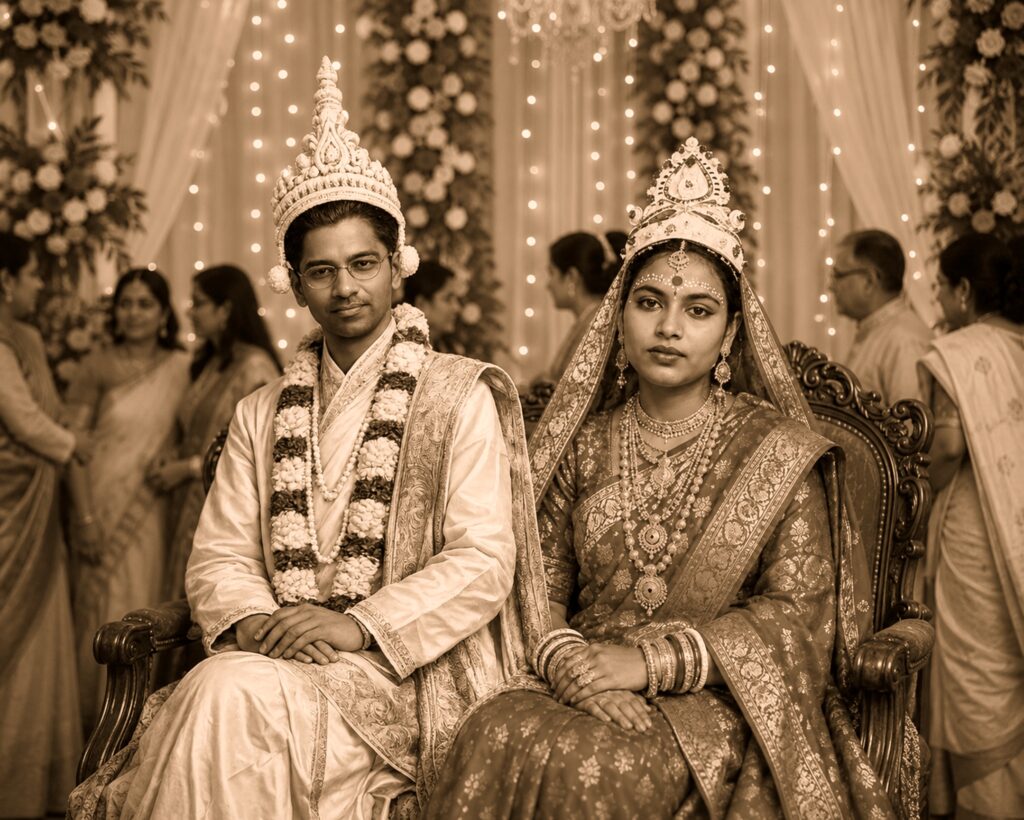
But after searching through the entire collection, I found only a single wedding photograph—a close-up portrait of Mother wearing the traditional Bengali bridal topor. I distinctly remembered seeing, during my childhood, a photograph of both of them together on their wedding day, but that picture seemed to have vanished without a trace.
There was no choice.
Armed with an early portrait of Papa and Mother’s bridal photograph, I entered an unexpected collaboration with artificial intelligence. Using every historical detail our family could still remember, I began reconstructing scenes from their wedding, one image at a time.
At first I restored them in colour.
Then my wife gently interrupted.
“Make them black-and-white… or perhaps sepia. Colour photography wasn’t part of ordinary Bengali weddings in 1952.”
She was absolutely right.
Sometimes authenticity is more beautiful than colour.
2
It was 1 December 1952.
Winter had just begun to settle over Kolkata. The air carried that unmistakable early-December chill, just enough to make a light shawl feel comforting.
For Papa and Mother, however, the cold hardly mattered.
Both were restless, each in a different way, standing at the threshold of a life that was about to change forever.
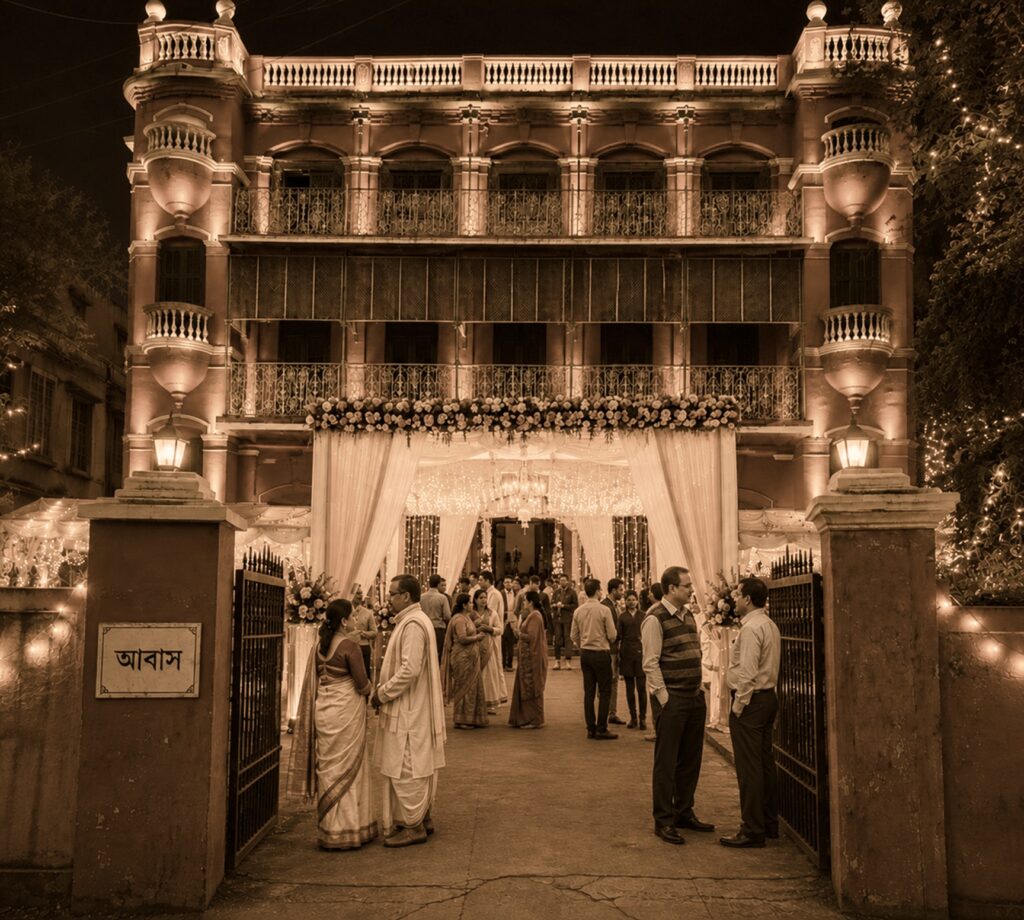
The wedding was taking place at the family residence known as Abas.
Yes—this was the day Papa and Mother were getting married.
There was another reason the household was overflowing with anticipation.
Pandit Ravi Shankar had promised that he would perform at the wedding reception of his student.
In the kitchen, Pishi was busy preparing an elaborate meal especially for the distinguished guest.
The house was overflowing with relatives.
Some admired every arrangement.
Others found fault with almost everything—as only relatives can.
Borodi Pishi worried constantly.
“Once Khokan’s wedding is completed properly, I’ll finally be able to relax.”
Grandfather, however, appeared remarkably calm. He had complete confidence in his children and believed everything would unfold as it should.
Chhordi Pishi was equally optimistic.
“Thakur will see everything through,” she said with quiet faith.
Papa’s worries were of an entirely different kind.
His greatest concern was not the wedding itself but whether Robuda—his beloved guru, Ravi Shankar—would be inconvenienced in any way.
He had arranged for Parimal Babu to accompany the sitar recital on the tabla.
But there was one problem.
No one could find him.
Not a trace.
What if he never arrived?
What would happen then?
The anxiety grew by the minute.
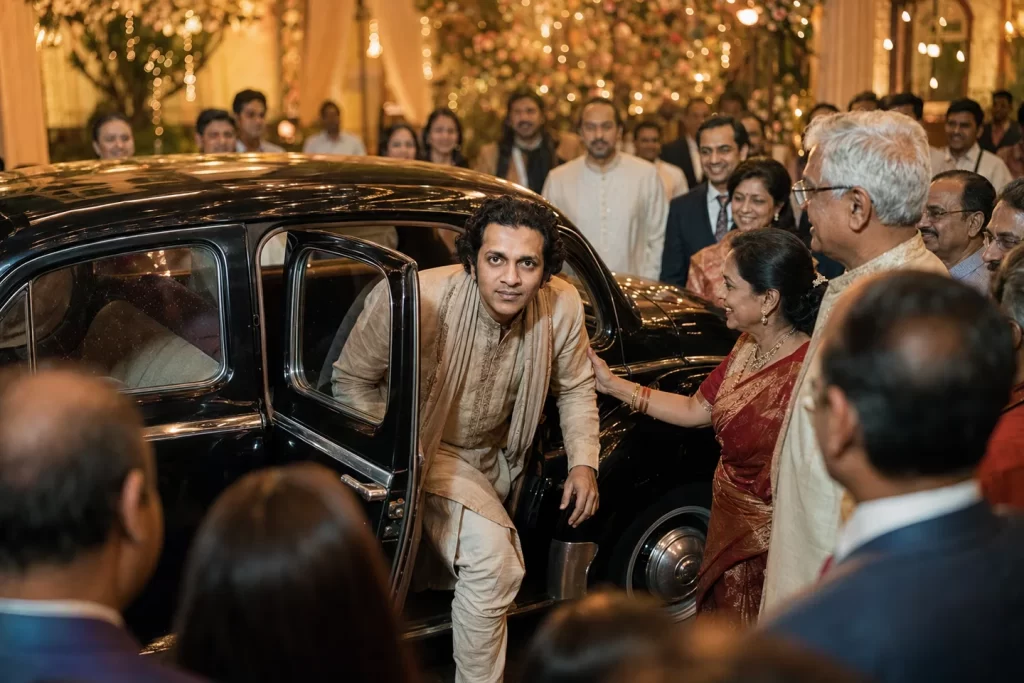
At last, two cars pulled up before the gate.
“Ravi Shankar has arrived!”
“Ravi Shankar has arrived!”
The entire household rushed toward the entrance.
Panditji stepped out of the car, accompanied by his disciple, Uma Shankar.
After warmly greeting the newly married couple, he was escorted to a special room.
Papa looked visibly distressed.
“Robuda,” he said hesitantly, “there’s been a problem.”
“What happened?”
“The tabla player I had arranged for you has disappeared. We have no idea where he is. What shall we do now?”
Ravi Shankar smiled reassuringly.
“Why are you worrying so much? Uma Shankar is here.”
“He will play.”
It was as though Papa’s heart started beating again.
Many people may not know that although Uma Shankar was an outstanding sitarist in his own right, he was also an accomplished tabla player.
With that single sentence, every cloud vanished.
The music began.
As Ravi Shankar’s sitar filled the house, the wedding ceased to be merely a social occasion. It became an offering. Melody flowed through every room, washing over the gathering like a sacred river. The house seemed purified by music itself, while the dreams of the newly married couple quietly began weaving the fabric of their future home.
Family members would remember that evening for decades—not only because a legendary musician had performed there, but because he had transformed an ordinary wedding into an unforgettable musical celebration.
There was one more memory that survived the passing years.
Everyone recalled how enthusiastically Ravi Shankar enjoyed the meal prepared by Pishi. He praised her cooking repeatedly, returning for one delicious dish after another.
Hearing such heartfelt appreciation from a guest she so deeply respected, Pishi’s face flushed with quiet happiness.
The exhaustion of an entire day’s labour disappeared in an instant, replaced by a gentle rosy glow that said more than words ever could.
Some memories fade.
Others become family legends.
This wedding belonged to the latter.