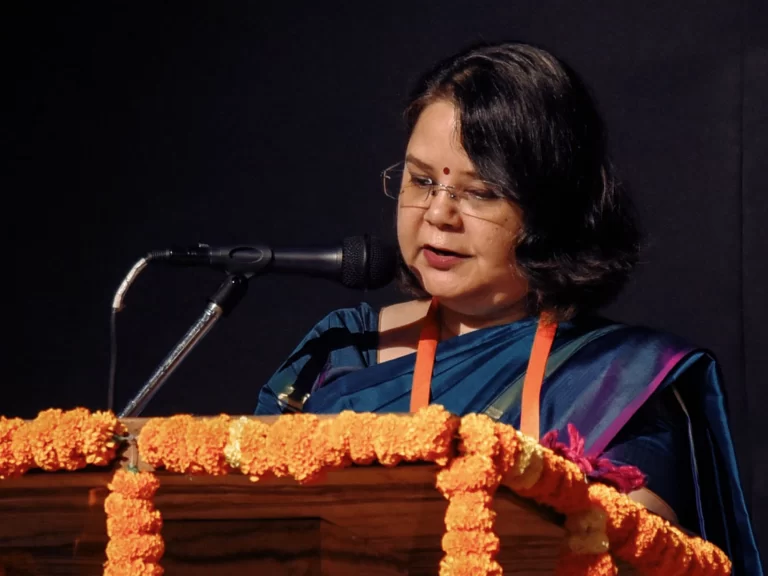
Dr. Pragya Pyasi

Dr. Pragya Pyasi, an Assistant Professor of Music at the University of Hyderabad, specializes in Hindustani classical music (Sitar). A disciple of Pt. Sanjoy Bandopadhyay, Dr. Pragya earned her M.A. and M.Phil. from Indira Kala Sangeet Vishwavidyalaya, Khairagarh (University Topper), and a Ph.D. from Bhatkhande Sanskriti Vishwavidyalaya, Lucknow. She qualified for the UGC-NET in 2012. For the last few years, Dr. Pragya has received notable support from her Guru, Professor Bandopadhyay, in developing her advanced research skills and academic vision.

Dr. Pyasi has published extensively in UGC CARE and SCOPUS-indexed journals, focusing on music pedagogy, stylistic analysis, and interdisciplinary studies. She received the Best Research Paper Award (2022) from Naad Nartan Journal and has guided MPA students for their paper publications in CARE and Peer Reviewed Journals, with two receiving Best Paper Awards (2023). An Assistant Editor for Naad Nartan and reviewer for Shodhkosh, she has presented at national and international conferences and delivered lectures as a Guest Speaker at institutions like Banaras Hindu University, Indira Kala Sangeet Vishwavidyala, and Bhatkhande Sanskriti Vishwavidyalaya.

She serves on Boards of Studies, Examinations, and Research Advisory Committees of reputed institutions. A recipient of the National Scholarship (MHRD), she has performed at prestigious festivals and actively promotes Indian art and culture through NGOs and rural music workshops.

Dr. Pragya Pyasi | Assistant Professor | Department of Music | SN School of Arts and Communication | University of Hyderabad
Phone: 9452669634 | Email: pragya.sitar at gmail.com and pragya at uohyd.ac.in

Educational Qualifications

  • Ph.D (Bhatkhande Sangeet Sansthaan Sam Vishwavidyalaya, Lucknow, 2017)
  • UGC NET (2012)
  • M.Phil. (Sitar) – Indira Kala Sangit University Khairagarh (2003)
  • M.A. (Sitar) – Indira Kala Sangit University Khairagarh (2002)

Specialization

Hindustani Classical Music – Sitar

Research Interests

Music pedagogy, Stylistic analysis of music, Interdisciplinary studies involving Music, allied art forms, and other disciplines.

Music Training

  • Basic training of Sitar under Shri. Rajiv Keshav Kelkar (Jhansi)
  • Currently learning sitar under Pandit Sanjoy Bandopadhyay, the eminent sitar maestro, academician, and an exemplary Guru.

Professional Associations

  • Member of Research Advisory Committee at the Department of Performing Arts, Assam University Silchar (a central university).
  • Assistant Editor in Naad-Nartan Journal of Dance and Music.
  • A reviewer with Shodhkosh: Journal of Visual and Performing Arts
  • Member of the panel of examiners for UG, PG, and Ph.D by Indira Kala Sangit Vishwavidyalay, Khairagarh
  • Member, Board of Studies, National Sanskrit University, Tirupati.

Awards

  • ‘Best Research Paper Award’ by ‘Naad Nartan’ Journal of Dance and Music for the paper ‘Presence of Hindustani Raga Music on YouTube and the Relative Positionings of the Musicians and Music Rendering Styles’ (2022)

Publications

  • The article “Impact of Globalisation on Indian Music After Independence” in the book New Dimensions in Indian Music (Kanishka Publications, New Delhi, 2012)

Articles

  • ‘Kandinsky and Mishra’s Synesthetic Approach in Portraying Music: A Comparative Analysis’ with Dr. Mukta Kulshreshtha IMEJ, International Multidisciplinary e-Journal (ISSN – 2277 -4262) in September 2024.
  • ‘Comparing Emotional Quotients: A Study of Undergraduate and Postgraduate Students in Music and Non-music Disciplines’ in UGC CARE listed journal Sangeet Galaxy (ISSN: 2319 – 9695), Vol. 13, No.2 (July 2024).
  • ‘Music Preferences and Consumption Habits Among Students of Hyderabad University: A Study Based on Digital Music Platforms’ Co-authored with Mohit Mehta in UGC CARE listed Naad Nartan Journal of Dance and Music, Volume: 12, Issue-2, April 2024 (ISSN: 2349-4654).
  • ‘Comparative Analysis of Ghazals and Nazrul Geeti: Exploring Musical and Cultural Dimensions’ co-authored with Rakiba Islam Oyshi and Saugat Mani Rasily in UGC CARE listed Naad Nartan Journal of Dance and Music, Volume: 12, Issue-2, April 2024 (ISSN: 2349-4654).
  • ‘Four Generations of Imadādkhānī Gharānā: A Critical Study of Jhālā’ in Pranav Journal of Fine Arts (ISSN- 2582-9513), Volume -2, Issue – 4, in February 2024.
  • ‘A Comparative Study of Kanhaiyā daṃgal and Huraṃgā of Rajasthan A Participant’s Observation’ in Pranav Journal of Fine Arts (ISSN- 2582-9513), Volume -2 Issue – 4, in February, 2024.
  • ‘Do the YouTube views count reflects the seniority and acceptance of Indian classical musicians within fraternity or the vice-versa?’ In UGC-CARE Listed Journal “ Naad-Nartan Journal of Dance & Music ” Volume -10, Issue-1, (ISSN: 2349-4654) , June 20227.
  • ‘Defining Hindustani Raga musicians and their relative intra statuses: An analytical study’ (published in a Web of Science and SCOPUS indexed journal ‘Rupkatha,’ Vol XIII, Apr-June, 2021).
  • Aesthetic and Literary Visualisation of Raga (published in Saam Bharati – 2019).
  • Methods and Sources of Data Collection for Research in Music (published in International Inventive Multidisciplinary Journal- 2018).
  • Divyata Ki Chhaap (Published in Bhartiyata – 2018).
  • Music Therapy: An Experiment with My Students (published in Music Therapy2011).
  • saMgIta meM dUrastha shikShaNa: saMbhAvanAeM (published in Kala Saurabh 2011).

Academic Outreach

Seminars

  • Presented a research paper titled ‘Impact of Indian Classical Music Exposure on Student’s      Cultural Intelligence: A Study Focused on University of Hyderabad Students’ at the     National conference organized by Naad Nartan at Bhatkhande Sanskriti    Vishwavidyalaya, Lucknow, from the 26-28th September 2024.
  • Presented a research paper titled ‘Tradition Redefined: Pandit Sanjoy Bandopadhyay’s Innovative Approach to Sitar Pedagogy’ at the International Seminar on Media and the   Changing Landscape of Music held during 13-14th March, 2024 organised by the Department of Instrumental Music, Rabindra Bharati University, Kolkata.
  • Presented a research paper titled ‘A Critical Review of Work Done by Indian Scholars on Computer Music During the Last Three Decades’ 5th 3-Day National Seminar on Music and       Technology organized by the esteemed organization ‘Naad Nartan’ in association with the      Ministry of Culture, Govt of India; in Jaipur, from 21st to the 23rd September 2023.
  • Presented a research paper titled ‘Exploration of Innovations and Traditional Knowledge Transfer Methods in Pandit Sanjoy Bandopadhyay’s Indian Classical Music Pedagogy: A Case Study’ at the Two-day International Conference on Indian Music (ICIM 2023) held during 6-7th November, 2023 organized by School of Liberal and Creative Arts (Films, Theatre and Music), Lovely Professional University, Punjab.
  • Presented a research paper titled ‘Comparing Emotional Quotients: A Study of Undergraduate and Postgraduate Students in Music and Non-music Disciplines’ at the          International Conference on Interdisciplinary Possibilities in Music, held during 6-7th    December 2023, organized by the Department of Music, Girdari Lal Dogra Memorial     Government Degree College, Hiranagar, in collaboration with Department of Higher Education UT J&K.
  • Presented a research paper titled “Four Generations of Imadādkhānī Gharānā: A Critical Study of Jhālā in “Parishodhana”, the Two day National Conference on Musical Forms and Indian Music and Temple Dance traditions, organized by JAIN (Deemed-to-be University), Bengaluru (January 27th-28th, 2023)
  • Co-authored and guided a research paper titled “A Comparative Study of Kanhiyā Dagal and Huragā of Rajasthan: A Participant’s Observation” with an MPA IV Semester student Mohit Mehta  for “Parishodhana”, the Two day National Conference on Musical Forms and Indian Music and Temple Dance traditions, organized by JAIN (Deemed-to-be University), Bengaluru (January 27th-28th, 2023)
  • Presented a research paper titled “Does the YouTube View Counts Reflect the Seniority and Acceptance of Indian Classical Musicians within the Fraternity or the Vice-Versa?” in the 4th Two day National Seminar organized by Naad Nartan in association with the Ministry of Culture, Govt. of India. (February 12 th -13 th , 2022).
  • Presented a paper at an International Seminar organized by Banglar Puratattva  Gabeshana   Kendra Kolkata on “Aesthetic and Literary Visualisation of Raga” 23/11/2018  
  • Presented a paper at an International Seminar organized by SNDT Pune on “Methods and Sources of Data Collection for Research in Music” – 06/10/2018
  • Presented a paper at an International Seminar organised by Maharaja Sayajirao  University Baroda on “svAtaMtryottara kAla meM saMgIta kA saMrakShaNa”-  29/03/16  
  • Presented a paper at an International Seminar organized by Indira Kala Sangit  University Khairagarh on “Impact of Globalisation on Indian Music After Independence”– 26/02/12  
  • Presented a paper at an International Seminar organised by Kriti Kala Sansthaan, Agra, on “Arts Funding in India”– 28/01/12  
  • Presented a paper titled “Music Therapy : An Experiment With My          Students”at a National Seminar organized by DGPG College Kanpur  – 04/12/10 

Papers Co-authored

  • ‘Ayodhya’s Kirtan Tradition and Its Socio-Cultural Aspects and Connections’ with Dr. Asmita Mishra at the 6th National conference organised by Naad Nartan at Bhatkhande Sanskriti Vishwavidyalaya, Lucknow, from the 26-28th September, 2024.
  • ‘The Significance of Print Media in Preserving and Popularizing Indian Classical Music’ with Dr. Asmita Mishra for the 5th 3-Day National Seminar on ‘Music and Technology’ organised by the ‘Naad Nartan’ in association with the Ministry of Culture, Govt of India in Jaipur, from the 21st to the 23rd September 2023.
  • ‘Kandinsky and Mishra’s Synesthetic Approach in Portraying Music: A Comparative Analysis’ with Dr. Mukta Kulshreshtha for the International Conference on Interdisciplinary Possibilities in Music, held from 6-7th December 2023, organized by the Department of Music, Girdari Lal Dogra Memorial Government Degree College, Hiranagar in collaboration with Department of Higher Education UT J&K.

Students’ Papers Guided and Co-authored

  • ‘Music Preferences and Consumption Habits Among Students of Hyderabad University: A Study Based on Digital Music Platforms’ – Mohit Mehta (Awarded Best Paper)
  •  “Comparative Analysis of Ghazals and Nazrul Geeti: Exploring Musical and Cultural Dimensions” – Rakiba Islam Oyishi and Saugat Mani Rasily (Awarded Youngest Researcher’s Award)
  • ‘Light Classical Forms in Odissi and Hindustani Music: Uncovering Similarities and Differences’ – Sai Sudeep Das
  • ‘Kanhaiyā Dangal: A Cultural Confluence of Faith and Entertainment’ – Mohit Mehta
  • ‘Exploring Hindustani Raga Music Components in Nusrat Fateh Ali Khan’s Qawwali Performances’ –  Karan Malik
  • ‘Analysis of the YouTube Presence of Hindustani Raga Music Vocalists with Special Reference to the Gender and Genre Dynamics’ – Prerana Sharma
  • ‘Structural Analysis of Taan-s in Pandit Nikhil Banerjee’s Sitar Performances: Study on selected commercial recordings’ – Saugat Mani Rasaily 

Professional Activities

  • Performed in various cities and participated in several cultural meets
  • Winner in several University level competitions and UP Sangeet Natak Academy State level competition
  • Awarded National Scholarship from the Ministry of Human Resource Development (2001)

Other Activities

  • Published literary works in Kadambini
  • Associated with two NGOs working for Indian Art and Culture
  • Worked as Director of AAROHAN (Jhansi) and Secretary of TWISHA, Jeypore (Odisha)
  • Organized programs and competitions at the state level in UP and Odisha
  • Organized workshops in schools in remote areas of Odisha and Uttar Pradesh

Bilasi-Yaman | An Accidental Raga

Born on 22 May 2024 at 9:40 a.m. IST

Sanjoy Bandopadhyay

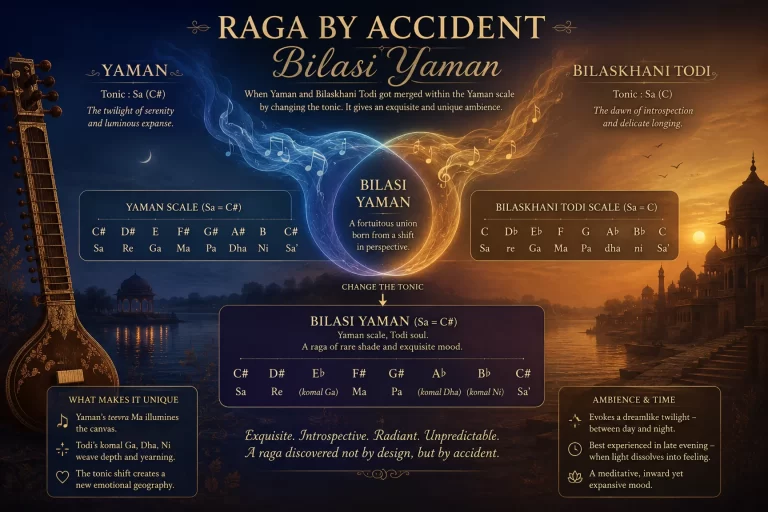
On May 22, 2024, during an insightful musical session with Dr. Adrian McNeil, we explored the concept of how murcchanā can transition focus from the hands to the mind, effectively diminishing physical awareness while playing an instrument.

The above audio example of Bilasi-Yaman was not there till my Gurubhai Jon Barlow wrote in a message that it does not make much sense unless there is an audio demo. So, it is there now. Jon wrote the message on December 28, 2024, and the recording, processing, and uploading happened the next day, on the 29th of December.

This discussion sparked the idea of composing a raga that artfully blends the evocative moods of Bilaskhani Todi with the foundational notes of Yaman, retaining Yaman’s essential swaras: S, R, G, m (tivra), P, D, N. This fusion is straightforward and uses Nishad-Murchhana to infuse the atmosphere of Bilaskhani Todi. When Nishad-Murchhana is applied, it shifts into the Bhairavi scale, incorporating komal r, komal g, and komal-d. The resulting scale is illustrated below:

Notation System:

  • Shuddha Svaras: S R G M P D N
  • Vikrit Svaras: r g m d n
  • Tar Svaras: S’
  • Mandra Svaras: N1

Dr. McNeil suggested that this raga may be considered a Chhayalag raga. Yes, this shows a unique Chhayalag quality, where two ragas create their respective moods using the same group of notes.

For Bilaskhani Todi, the Yaman note Equivalents:

N1 = S | S = r | R = g | G = M (shuddha) | m (tivra) = P | P = d | D = N | N = S’

In Bilasi-Yaman, two types of notes and their positioning differ when depicting Yaman and Bilaskhani Todi (BT). Given that Yaman applications are well-known, we will focus on the unique note positions when invoking BT.

For example, to evoke the essence of BT’s rn1Srg, which is S ND1 N1 S R, from Yaman’s perspective, the S will adjust to reflect BT’s komal-r effect.

Another important note is that when the raga takes the course of Bilaskhani Todi, the note positions will naturally change from their Yaman positionings.

Naming of the Raga

The naming of the raga was not easy. Initially, I thought of Yaman-Todi, and later, I considered options like Yamani-Todi. But it was not good, as I wanted to compose an evening raga. Yaman-Todi or Yamani-Todi indicates association with morning because the ending is tagged with Todi, a morning raga. So, the first idea update was Bilaskhani-Yaman, which was later finalized as BILASI-YAMAN, where the ‘Bilasi’ connects to Bilaskhani Todi.

As a raga under the Yaman-veda, Bilasi-Yaman emphasizes the Yaman aspect, making it an evening raga. The innovative blending of these two ragas creates a unique and sophisticated musical experience, harnessing Yaman’s elegance with Bilaskhani Todi’s softness.

Musical Translation

Music is a creative expression of human experiences, a medium of expression applying different skill sets. So, music mostly tries to express human experiences and emotions as approximate and creative translations.

The following audio-video mix aims to create musical visualizations of raga music quickies. These videos are recreations of music in visual forms. These videos surely are not examples of reverse engineering but may be termed “Creative Reverse Engineering”, where the music is a source of fresh ideas expressed in non-music media.

Moonlit Night with Chandni-Kalyan
Musical Translation-II

Best Paper Award to Pragya

I am indeed thrilled that on September 23, 2023, Naad Nartan felicitated Dr. Pragya Pyasi with the Best Paper award for their 2022 National Seminar organized in collaboration with the Ministry of Culture, Government of India.

Pragya is the first among my disciples to get felicitated for excellence in
academic writing!

Her paper titled ‘Do the YouTube Views Count Reflects the Seniority and Acceptance of Indian Classical Musicians within Fraternity or the Vice-Versa?’ was published in UGC CARE Listed Naad-Nartan Journal of Dance & Music [ISSN:2349-4654], Vol-10, Issue-1, June 2022, DOI: https://zenodo.org/record/7056304

Pragya is the first among my disciples to get felicitated for excellence in
academic writing!

Here is an insertion from a Facebook post of September 26, 2023.

Dr. Pintu Saha [pen name Pramit], Head of the Department of Music at Assam Central University, commented below…

Four rAga-s taking Re-Ga-Tivra-ma and komal-dha

Let us have some music first.

When you wish to stroll away and read the poetic interpretations of pragyAdhArA; please scroll down.

Self Incarnated pragyAdhArA

The beginning

Pragya, my disciple Dr Pragya Pyasi, called me in the afternoon, it was 05 October 2021. She asked if I knew any raga that takes Shudh Re, Shudh Ga, Tivra m and Komal dha. I could not remember any such raga but thought rendering of ‘Maru-Vasant’ should take these notes. I shared the puzzle with some of my musician friends but received no solution.

The following day it occurred that I could try to frame some ragas with these notes. Here are four ragas that came to me immediately. However, later I remembered that there was a raga ‘Purvi-Kalayan’ but not popular. On YouTube search, I discovered ‘Maru-Vasant’, but that takes both the M and m. 

A few days later, Professor Rajesh Shah of Banaras Hindu University and Sri Anindya Banerjee, Kolkata, pointed out a Carnatic raga ‘latAngI’ that takes these notes. I then realized that it slipped off my memory, and I remembered I certainly listened to Nikhilda [Pandit Nikhil Banerjee] playing ‘latAngI’. 

Ragas that take R G m [Tivra] and d [Komal]  |   P1= Mandra P

1.         Maru Vasant

Arohan: S G m P m G m d S’

Avarohan: S’ N d P m G, m G R S R – S

2.         Vishnu Kalyan

Arohan: N1 R G m d N S’

Avarohan: S’ N d P m G P GR – S  

3.         Purvi Kalyan 

Arohan: N1 R G m d N S’

Avarohan: S’ N d P m P G M G, G m P GR – S

4.         Pragyadhara

The idea of naming this raga as pragyAdhArA came to me as Pragya first put before the R-G-m-d puzzle before me and that was the source of the birth of this raga. You can listen to a brief AlAp on this raga in the audio-clip at the top.

This is a chalan based raga. 

Chalan:

A.         SP1 – S – R S, N1 S GR, N1 S R G N1 S R P1 d1-

B.         N1 m m G GR S, d1 P1

C.         P1 G – R, R m P GR – S, d1 P1 S

D.         m1 P1 S-, P1 S G d – P

E.         G m P d – m, GmPdN- N d P, m G – R

F.         R G m d, R G N d P

G.        R G m d, R G m P, G N N D P

H.        m G R, R G m d, m d N S’

I.          d N S’ R’ G’ R’

J.          P S’ – R’ S’, S’ N d P G -, m G GR – S

Arohan: P1 S R S, N1 S R G m G, m G R G m d P, m d N S’

Avarohan: S’ N d P G, m G R S

Version II

Pragyadhara – II

  1. S G P G, m d m G, PG S GR
  2. P1 S G – S, N1 R N1 P1 d1
  3. d1 N1 R G R N1 d1 P1 S
  4. P1 N1  S G  – S, P1 S GR
  5. S G P, m d – P
  6. m d N, m d, G P, P G S GR
  7. S G P S’ N m d m G, PG S
  8. G P S’ R’ S’ N  R1 P d
  9. S’ N P d m G, P G S R – S

Important combinations:

  1. S G P
  2. N1 R N1 P1 d

Poetic Interpretations of prgyAdhArA

Medha Persaud* writes in a WhatsApp message on 07 October 2021

In the early morning, 

Just after dawn,

When the sun is but a 

painting in the sky,

There is a gentle rain

Ever so light,

a wisp,

tip tapping on flecks of light

Softly

Softly

Softly…

That is how I feel after listening to this creation.

Fire and water at their gentlest. Is the sun reflecting the water or is the water reflecting the sun? No one knows because your raga doesn’t say. Beautiful. pragyAdhArA is born.

* Medha Persaud [nee Ramnath] visited India during 1990’s to learn sitar. She took admission at the Khairagarh University. Now, Medha is serving as a Senior Scientist in Molecular Biology and Genetics in a Biomedical Company in New Jersey [USA].

Remembering VK on the 2nd night of 2013

First posted on January 5, 2013 by sitardivine

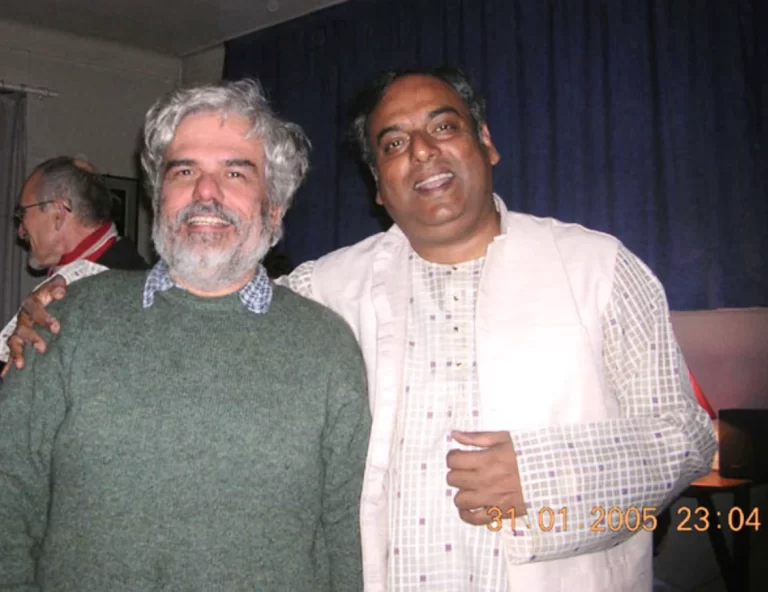
L to R : Pt.Sanjoy Bandopadhyay, rabbi Eduardo, Jon Barlow

Vilayetkhani Kanada

2012 was about to end, it was a cold December morning. I received a phone call from my dear Jon. Jon Barlow is a kind of an omnipresent person in the Hindusthani music scenario. He can be seen anywhere in India or different parts of the globe… be it Kolkata, Dharwad, Goa, Mumbai,  Paris or Sydney. This senior gurubhai wanted me to give a performance. He offered two dates to choose from, one was the 1st January night or the 2nd .   I was free on the 2nd and choose to play on this day. Later I found out that the concert would be  at Dupli’s residence [Dr. Kingshook Biswas] and I became even happier.

I reached the mathematician’s den in the evening and pleased to discover many close friends and some serious musicians assembled to listen to the music. Prabhu Edouard, the tabla maestro from Paris, was already there. Jon had already told me that Prabhu would provide me with the tabla support. I started with Sajgiri followed by a Madhya laya gat in Anandi-Kalyan. The audience request came for Kirwani. So, that became the next item. I remembered that I last played the raga at Swami Haridas Sangeet Sammelan in Bombay long back in 1976.  When I finished Kirwani it was about 10 at night.  The audiences wanted more so we decided to sit again after dinner! The famous Bablu, who has been serving Jon for the last 30 years [or longer?] cooked for us a tasty dinner. Babui was with me. Babui has become quite a notable sarod player [Saugata Roy Chaudhury] and regularly performing in venerable venues in Europe. We were discussing on what can be the next raga. Suddenly it clicked… why not try ‘Vilayatkhani Kanada’?… He liked the idea very much and became quite excited.  I  never seriously tried this raga and did not have the opportunity to even listen to Ustad Vilayat Khan excepting a glimpse for say 5 mins. So I plunged into Vilayatkhani Kanada.

I had a tiny voice recorder with me. It was not a very good one. I could not position the microphone nicely. so many  details are lost.. still I thought it  is not too bad an idea to put it before you.. although a scratchy recording. I hope you, as a connoisseur will fill the gaps…

Click here to listen to the Vilayetkhani Kanada (bhIlAyetkhAni kAnARA)

Posted in PerformancesZ-Space. Tags: . Bookmark the permalinkEdit

Pandit Radhika Mohan Maitra’s pedagogy

It was the 1st of February 2021. I was leisurely thinking of my half-pant days, my school, my tiny sitar, Ustadjee. Suddenly my phone rang. It was Ms. Shailaja Khanna from New Delhi. Shailaja is a regular columnist of Music for several renowned Indian dailies. She wanted me to talk about the pedagogy of my Ustadjee and limit it to around 3 minutes. She told that she was planning to present a program on the 105th Birthday of Pandit Radhika Mohan Maitra on the TV channel Insync.

Shailaja Khanna
Shailaja Khanna

This sudden request was a tough test for me. To talk about Ustadjee’s teaching style and wrap up within 3 to 4 minutes was not easy as licking one’s favorite ice cream. I told Shailajajee to give me a little time. I wanted to identify some quick points and generate some deliverable concept on which the talk can stand. I said yes after two days. Here is the 3 min. 40 secs. video. 

Professor (Pt.) Sanjoy Bandopadhyay talking on his Guru Pandit Radhika Mohan Maitra

I could not adequately explain some points in the video. One was about prefixing such a phenomenal musician’s name with ‘Shri.’ Yes, you got it right, Ustadjee did not like his name to get prefixed by Pandit or the likes. He used to tell that he was Shri Radhika Mohan Maitra. 

Music Album ‘Rare Ragas on the Sitar’ – A Collector’s Item

Music Album ‘Rare Ragas on the Sitar’ – A Collector’s Item

This album is available worldwide through renowned music distributors including amazon.com and iTune.

First Posted on February 16, 2016 by sitardivine

Enjoy the Rare Music Album!

The music album ‘Rare Ragas on the Sitar’ is presenting a number of rare ragas those were never recorded for wide distribution earlier. This is indeed a collector’s item. A detailed musical analysis will be published shortly. For a starter here are some listeners comments those appeared in social media.

————————–

I love rarity, I love traditions, I love music. This album caters to all my yearnings… I am floored with the renderings.. These are rare and most of them are NOT available in recorded format. I feel proud to recommend this to all my friends on this very special Valentine’s Day!

Madhuparna Banerjee, February 14 at 11:26pm / Facebook on the music album

——————————-

not only a listener’s joy… this album is a precious collection for lifetime. all the ragas were unheard to me. any amount of thanks is not enough for the maestro. undeniably wonderful. do listen and enjoy.

Troilee Dutta, February 15 / Facebook

————————————

Hi Freiends Pls listen this special CD on this Valentine’s Day .Its a rare CD of Rare Ragas. I hope you will enjoy it …..

Indranil Mallick, February 14 at 10:39pm / Facebook

—————————————-

The rarest ragas along with a unique style of Sitar performance……got the opportunity to listen to all the seven ragas that kept me stunned…..buy the CD from ITunes store or contact the above number….my frndz can contact me also for this rare collection…..must listen

Anirban Banerjee,  February 14 at 3:52pm / Facebook

——————————

great nourishment of unheard ragas in Indian classical music.unbelievable creation.

Nabamita Roy· February 14 at 6:44pm / Facebook

——————————

Critical analysis

The Sitar

Coming shortly

The Tabla

Detailed analysis is coming shortly.

Summary

Dilip Mukherjee [DM] in this CD provided tabla support in six different taalas in different layas. Some of the sitar compositions were offbeat and unique. The easy flows of the renderings were highly commendable. Listeners will feel at ease even when they listen to the not-so-common taalas like Chaar Taal ke Sawari. The performance flow was like that of Trital. I mentioned Trital, because this is a tala that we commonly listen to and musicians commonly have command.

DM’s aesthetic sense and musical approach nicely justified the raga moods. It was a happy feeling to listen to some tabla support that especially took care not to over-do. It gave affectionate and careful support giving higher priority to the musicality. Even then, the tihais, and the divisions within the compositions, multiple speed variations [layakari] were awe-inspiring and thoroughly enjoyable.

The CD is a  a Collector’s Item and a treat for all groups of listeners.

The Tabla analysis was done by Pintu Saha. 

Pintu Saha

Pintu learned tabla with Pandit Shankar Ghosh, the tabla legend. Currently he is pursuing researches under the Ph.D. program at the Department of Instrumental Music, Rabindra Bharati University. A serious researcher Pintu Saha received Research fellowship SJRF [State Junior Research Fellowship].

Also visit ‘Mee Record’ Facebook page at https://facebook.com/meerecords

সেতার, বেড়াল ও জেসপা

First posted on May 13, 2014 by sitardivine

তখন আমরা ২০ বিধান পল্লীর বাসাবাড়ীতে থাকি. ওখানে রেলগাড়ীর ডিব্বার মত সারি দেওয়া তিনটে ঘর ছিল, তারপর রান্নাঘর আর এছাড়া একটা ঘর একটু আলাদা, সেখানে আমি রেয়াজ করতাম| সেদিন পাপা বাড়িতে, আমিও সেতার নিয়ে মাঝের বড় ঘরে চলে এসেছি| পাপা খাটে শুয়ে আছেন আর আমি মেঝেতে বসে বাজাচ্ছি| সে সময় বেশ বেড়ালের উৎপাত ছিল, আর মনে হয় বেড়ালের পপুলেশনও বেশ বেশি ছিল| কারণ খুব স্পষ্ট| এখান আর অত ঘন ঘন বেড়াল চোখে পড়েনা| যদিও বেড়াল পরিসংখ্যান কোথাও তেমন করে দেখিনি, তবে এ কথা নিজের অভিজ্ঞতা থেকে হলফ করে বলতে পারি| অন্য একটা সম্ভাব্য কারণ অবশ্য, বেড়াল সম্প্রদায়ের বুদ্ধি ক্রমশঃ কমে যাচ্ছে| এ সম্পর্কে বেড়ালবিদ পন্ডিতেরা আরও ভাল বলতে পারবেন| আমি যে কথা বলতে চাইছিলাম তা হচ্ছে মাছ, দুধ ইত্যাদি বেড়ালের জিভে না পৌঁছে যাতে আমাদের জিভ স্পর্শ করে তারই জন্য আমাদের জানালার শিক্গুলোতে লোহার তার লাগান হয়েছিল| খুব যে ঘন তা নয়, তবে সাধারণ বেড়ালের সাইজ থেকে বেশ ছোট|

আমার কোনদিন সেতারি হয়ে ওঠার ব্যাপারে পাপার প্রবল সন্দেহ ছিল| বলতেন, “এত নরম হাতে সেতার কি বাজবে, ডা-রাই বাজাতে পারিসনা|” এছাড়াও গান-বাজনার লাইনে এপাশ-ওপাশ থেকে গুঁতো খেয়ে গান-বাজনা পেশাদারী সম্পর্কে ওঁর অনেক বিপরীত বক্তব্য ছিল| তবে শেখাতে কার্পন্য করেননি| একটু এপাশ ওপাশ হলেই ভুল ধরিয়ে দিতেন|

সেদিন রেয়াজ করছি, বেশ মন দিয়েই বাজাচ্ছিলাম|সেতারে জোরে ঠোক মেরে রা-রা বাজাতে বেশ ভাল লাগত| মনের খুশিতে হঠাৎ মেরে দিলাম জোরসে ঠোক, তারপরেই ঘটে গেল সে ভীষণ ব্যাপার| দেখি, কিছু একটা সাদা লম্বাকার জিনিস পিঠে ধাক্কা দিয়ে, সেতারে ধাক্কা মেরে তীব্র গতিতে জানালার ফোকর দিয়ে ছিটকে বেরিয়ে গেল| তাকিয়ে দেখি তারের একটা ফোকড় বেশ কিছুটা বড় হয়ে গেছে আর তার চারদিকে সাদা লোম| পাপাও হঠাৎআওয়াজে ধড়মড়িয়ে উঠে বসলেন| সব কান্ড বুঝে চিৎকার করে উঠলেন, “দেখছিস তোর বাজনার বহর, বেড়াল কিভাবে ভয় পেয়ে পালাচ্ছে? বেড়ালের যদি এই হয় তাহলে মানুষের কি হবে ভাবতে পারছিস?” আমি কিছুটা মুষড়ে পড়লেও বাজনা থামালামনা|

এরপর বেশ কয়েক বছর কেটে গিয়েছে| আমি তখন লম্বা সময় ধরে রেয়াজ করি| নানা জায়গায় বাজাতেও শুরু করেছি| সে সময় কালীবাড়ী লেন-এ ওস্তাদজীর বাড়ির পরের গলিতেই একটা টিউশনি পেয়ে গেলাম| ছাত্রের নাম ‘দোলন’| সে আমার থেকে বয়সে অনেকটা বড় হলেও তা কখনও বুঝতে দেয়নি| ছাত্র-শিক্ষক সম্বন্ধের যথেষ্ঠ সম্মান করত| ওকে আমি বলতাম ‘ছাত্র বাবু’| সেই ছাত্র বাবুর একটা পেল্লাই সাইজের ডোবারমেন কুকুর ছিল| নাম ছিল ‘জেসপা’| দারুন স্মার্ট| একদিন শেখাতে  পৌঁচেছি, দেখি জেসপার মেজাজ খুব গরম| খুব জোরে চেঁচিয়ে চলেছে| অনেক চেষ্টা করেও তাকে শান্ত করা যাচ্ছেনা| ছাত্র বাবু, তার স্ত্রী, সবাই অনেক চষ্টা করে হাল ছেড়ে দিলেন| আমি ভাবলাম একটা পরীক্ষা করে দেখা যাক্| গুরুর নাম নিয়ে আমি সেতার হাতে তুলে হাল্কা করে আলাপ বাজাতে শুরু করলাম| অবাক কান্ড! কিছুক্ষনের মধ্যেই জেসপা-র চিৎকার কমে গেল, তারপর চুপ করে শুয়ে পড়ল| এ ত ম্যাজিক!! গুরুদের মুখরক্ষা হ’ল, অল্প হলেও আমার গুরুদের সেখান বিদ্যে কাজে লেগে গেল|

Hindi Translation

सितार, बिल्ली और जैस्पा
(पहली बार पोस्ट किया गया – 13 मई, 2014, sitardivine द्वारा)

उस समय हम 20 विधान पल्ली के मकान में रहते थे। वहाँ रेलगाड़ी के डिब्बों की तरह लाइन में तीन कमरे थे, फिर रसोई, और एक अलग कमरा जहाँ मैं रियाज़ करता था। उस दिन पापा घर पर थे, और मैं सितार लेकर बीच वाले बड़े कमरे में आ गया। पापा खाट पर लेटे हुए थे, और मैं फर्श पर बैठकर सितार बजा रहा था।

उन दिनों बिल्लियों का खासा आतंक था — लगता है बिल्ली जनसंख्या भी काफी अधिक थी। कारण बहुत स्पष्ट है, अब वैसी बिल्ली की भरमार नहीं दिखती। हालांकि बिल्ली जनगणना कहीं नहीं देखी, लेकिन अपने अनुभव से पूरी शपथ लेकर कह सकता हूँ। एक और संभावना भी है: शायद बिल्ली जाति की बुद्धि धीरे-धीरे घटती जा रही है — इस पर ‘बिल्लीतत्व’ के विशेषज्ञ पंडित ज़्यादा प्रकाश डाल सकते हैं।

मैं जो बात कहना चाहता था वह ये कि मछली, दूध वगैरह बिल्लियों की जीभ तक न पहुँच जाए और हमारे ही हिस्से में आए — इस उद्देश्य से हमने खिड़कियों पर लोहे की तार लगवाई थी। तारें बहुत घनी नहीं थीं, पर एक औसत बिल्ली के लिए अंदर घुसना मुश्किल था।

मेरे सितारी बनने को लेकर पापा को हमेशा संदेह था। कहते, “इतने नरम हाथों से सितार क्या बजेगा? डा-रा भी ढंग से नहीं बजा पाता।”
गायन-वादन को पेशेवर रूप से अपनाने को लेकर उनके विचार काफ़ी विरोधी थे — शायद उन्होंने इधर-उधर से ठोकरें खाई थीं। फिर भी उन्होंने सिखाने में कोई कंजूसी नहीं की। ज़रा सी भी चूक होती तो तुरन्त पकड़ लेते।

उस दिन मैं रियाज़ में डूबा हुआ था। सितार पर ज़ोर से ठोक कर ‘रा-रा’ बजाने में बड़ा आनंद आ रहा था। मन के उत्साह में मैंने एक ज़ोर की ठोक दी… और तभी हुआ एक अजीब हादसा!
देखता हूँ — एक लंबी सफेद आकृति मेरी पीठ से टकराकर, सितार पर धक्का मारकर खिड़की की सलाखों के बीच से बिजली की गति से निकल गई! देखा, खिड़की की तार का एक हिस्सा अब काफ़ी बड़ा हो चुका था और वहाँ सफेद बालों का गुच्छा चिपका था।

पापा भी उस तेज़ आवाज़ से चौंककर उठ बैठे। जब पूरी घटना समझ में आई तो झल्लाकर बोले,
“देख रहा है तेरी बजाने की धाक? बिल्ली डर के मारे भाग गई! अगर बिल्लियों की ये हालत है तो सोच इंसानों का क्या होगा?”
मैं थोड़ा मायूस ज़रूर हुआ, पर बजाना बंद नहीं किया।

इसके कई साल बाद की बात है। अब मैं घंटों रियाज़ करता, और अलग-अलग जगहों पर बजाने भी लगा था।
इसी दौरान मुझे कालिबाड़ी लेन में उस्ताद जी के घर के पास एक ट्यूशन मिल गई। छात्र का नाम था दोलन। उम्र में मुझसे काफ़ी बड़ा था, लेकिन व्यवहार में उसने कभी इसका अहसास नहीं होने दिया। छात्र-गुरु के रिश्ते का पूरा सम्मान करता था। मैं उसे ‘छात्र बाबू’ कहता था।

उस छात्र बाबू का एक बहुत बड़ा डॉबरमैन कुत्ता था — नाम था जेस्पा। बड़ा स्मार्ट जानवर था।
एक दिन मैं सिखाने पहुँचा तो देखा जेस्पा का मूड बहुत गर्म है। ज़ोर-ज़ोर से भौंक रहा है।
छात्र बाबू, उनकी पत्नी — सबने बहुत कोशिश की, लेकिन वो शांत नहीं हो रहा था।
मैंने सोचा, एक प्रयोग करते हैं।

गुरु का नाम लेकर मैंने सितार उठाया और हल्के सुरों में आलाप बजाना शुरू किया।
हैरत की बात! कुछ ही पलों में जेस्पा की आवाज़ धीमी पड़ने लगी — फिर एकदम शांत होकर ज़मीन पर लेट गया।

ये तो जादू था!
गुरुजनों की लाज रह गई — और थोड़ा-बहुत सही, उनकी दी हुई विद्या ने अपना काम कर ही दिया!