

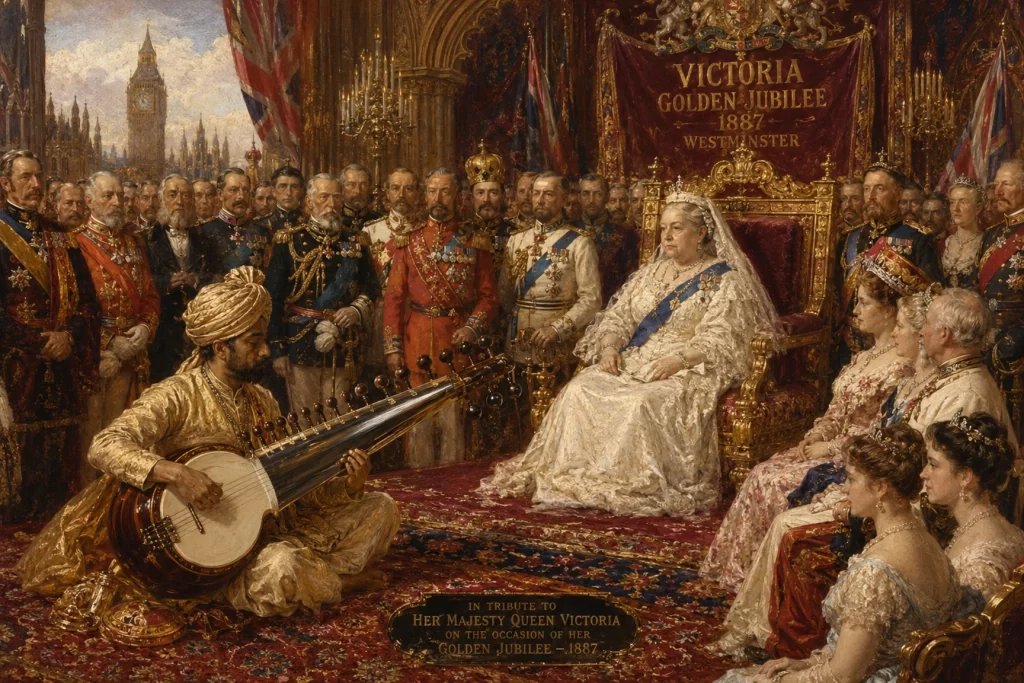
Sanjoy Bandopadhyay had never trusted old instruments.
Not because they were unreliable. Quite the opposite.
They remembered too much.
The trouble began on a monsoon evening in Kolkata in the year 2026.
Outside his study, rain hammered the mango trees with such determination that the world beyond the window had dissolved into a grey curtain. The professor sat alone before his computer, surrounded by books, manuscripts, concert programmes, photographs and half-forgotten notes collected during a lifetime spent chasing stories hidden inside music.
On the screen glowed a digital archive.
He had been cataloguing oral narratives about great musicians of the nineteenth century.
One recording in particular had captured his attention.
An elderly musician was recounting a strange incident involving Ustad Enayat Khan, Queen Victoria’s Silver Jubilee, and a Sarod that had once been accused of containing secret machinery.
Sanjoy smiled.
Only musicians could produce stories that sounded simultaneously impossible and completely true.
He adjusted his headphones and listened again.
The old voice crackled through the speakers.
“…they brought a screwdriver…”
A flash of lightning illuminated the room.
“…opened the metal plate…”
Thunder shook the house.
“…inside there was nothing…”
The recording suddenly distorted.
The speaker’s voice deepened.
Stretched.
Echoed.
For a moment Sanjoy thought his headphones had malfunctioned.
Then another voice emerged.
A voice unlike any he had ever heard.
Soft.
Ancient.
And unmistakably amused.
“Nothing?”
said the voice.
“Who told them there was nothing?”
Sanjoy removed his headphones immediately.
The room was empty.
Yet somebody had spoken.
The rain continued outside.
The computer screen flickered.
Again the voice came.
“Music has never understood the difference between emptiness and fullness.”
Sanjoy stood up.
A sensible man might have switched off the machine.
A wiser man might have left the room.
Instead he leaned closer.
The archive window had vanished.
In its place appeared an image.
At first it seemed to be an old photograph.
Then he realised it was moving.
Horse carriages.
Gas lamps.
Men in Victorian clothing.
The image was alive.
His heart began pounding.
The computer screen should not have been deep.
Yet somehow it possessed depth.
A street extended into the distance.
Fog drifted between buildings.
Somewhere a church bell rang.
Most alarming of all, he could hear music.
Very faintly.
A Sarod.
Playing from somewhere beyond the image.
The melody seemed impossibly distant and impossibly familiar at the same time.
The voice returned.
“Stories are doors, Professor.”
The room suddenly smelled of wet cedar wood and lamp oil.
“Some doors open only when somebody listens carefully enough.”
The music became louder.
The fog inside the screen swirled.
Sanjoy took an involuntary step backwards.
Unfortunately, the floor beneath him disagreed with the laws of common sense.
Instead of moving away from the screen, he appeared to move toward it.
Bookshelves stretched.
Walls bent.
The room folded like paper.
For one impossible second he found himself suspended between two worlds.
He glimpsed hundreds of images rushing past.
A workshop in Lucknow.
A railway platform.
A royal procession.
Musicians tuning instruments.
Craftsmen carving bridges.
Strings vibrating.
Hands teaching hands.
Teachers teaching disciples.
Notes passing from one generation to another.
Then everything vanished.
A cold wind struck his face.
He stumbled forward.
Cobblestones met his shoes.
Gas lamps glowed overhead.
The smell of coal smoke filled the air.
Carriages rattled past.
Someone shouted in English.
Another voice answered in Urdu.
A newspaper boy ran by carrying an evening edition.
The headline stopped Sanjoy’s breath.
SILVER JUBILEE CELEBRATIONS OF HER MAJESTY QUEEN VICTORIA
Sanjoy stared.
Then looked again.
The date remained unchanged.
For several moments he simply stood there.
Rainwater dripped from his coat.
Horse-drawn traffic moved around him.
No one appeared remotely surprised by his presence.
A gentleman brushed past while consulting a pocket watch.
A woman carrying flowers hurried across the street.
Two policemen discussed crowd-control arrangements for the Jubilee festivities.
The city behaved as though it had always contained a Bengali music professor from the twenty-first century.
Somewhere nearby, faintly but unmistakably, he heard the sound of a Sarod.
The same melody he had heard through the archive.
A curious sensation travelled through him.
Not fear.
Not excitement.
Recognition.
Like a musician hearing the opening phrase of a familiar raga after many years.
The music seemed to be inviting him somewhere.
Sanjoy followed the sound.
The melody drifted through the London fog like a thread being drawn through cloth. Sometimes it seemed close enough to touch. At other moments it retreated into the distance, as though teasing him.
He turned into a narrow street lined with brick buildings blackened by coal smoke. A horse-drawn omnibus rattled past. Somewhere nearby, a newspaper vendor shouted the latest Jubilee news. The Empire appeared to be celebrating itself with remarkable enthusiasm.
Yet beneath all that noise the Sarod continued to sing.
As he walked, a curious realization began to dawn upon him.
The music was not merely guiding him through space.
It was guiding him through history.
The sounds around him were changing.
A church bell rang.
Immediately another sound answered it.
Not a bell.
A tanpura.
The deep resonance floated through the air for a moment before vanishing.
Further ahead, a blacksmith struck metal with a hammer.
The ringing note transformed itself in Sanjoy’s imagination into a perfectly tuned Pancham.
The clatter of carriage wheels became a rhythmic cycle.
The hiss of steam escaping from a locomotive resembled an extended meend.
For the first time in his life, he felt he was walking inside music itself.
Perhaps, he thought, this was how the great masters heard the world.
The idea both thrilled and unsettled him.
Then he noticed something extraordinary.
People.
Not ordinary people.
Musicians.
Some walked directly past him.
Others appeared only briefly before disappearing into the fog.
A dignified dhrupad singer carrying a rudra veena.
A young sitar player from Lucknow.
A court musician from Rampur.
A tabla player whose face Sanjoy recognised from a century-old photograph.
None appeared surprised by their surroundings.
Nor did they seem surprised by him.
They moved through London as naturally as Londoners moved through London.
The realization struck him with almost physical force.
The Jubilee was attracting not merely politicians, soldiers and aristocrats.
It was drawing musicians from across the Empire.
The city had become a temporary capital of sound.
An impossible congress of traditions.
A crossroads where musical worlds intersected.
The concept delighted him.
As an educator, he had spent decades trying to explain that musical history was not a sequence of isolated geniuses. It was a network.
Teachers.
Disciples.
Instrument makers.
Patrons.
Audiences.
Travellers.
Every great musical tradition was a living ecosystem.
And now, somehow, he had stepped directly inside one.
The melody led him into a large square illuminated by gas lamps.
At its centre stood a bronze statue.
Around its base sat several Indian musicians conversing in a mixture of Urdu, Persian, Hindi and English.
Sanjoy approached cautiously.
One elderly gentleman looked up.
His eyes narrowed.
Then widened.
“Ah,” he said.
“Another listener.”
The remark startled Sanjoy.
“Another listener?”
The old man nodded.
“Every few generations someone arrives.”
“What do you mean?”
Instead of answering, the man pointed toward the sky.
Above London the clouds were beginning to part.
Moonlight touched the rooftops.
“You hear them, don’t you?” he asked.
“Hear whom?”
“The notes.”
Sanjoy hesitated.
“Yes.”
The old man smiled.
“I thought so.”
For several moments nobody spoke.
Then another musician, a bearded sarangi player, leaned forward.
“Tell me,” he asked, “which century do you come from?”
The question nearly stopped Sanjoy’s heart.
Before he could formulate a reply, laughter erupted around the group.
Not cruel laughter.
Warm laughter.
As though everyone already knew the answer.
The elderly gentleman rescued him.
“Do not worry. Time behaves strangely around music.”
“Who are you people?” asked Sanjoy.
The old man considered the question.
“Some are musicians.”
He pointed to the others.
“Some are makers.”
Then he touched his own chest.
“And some are custodians.”
“Custodians of what?”
The answer came quietly.
“Memory.”
A silence followed.
Somewhere distant, a clock struck midnight.
The musicians listened respectfully.
Then one of them said something that would remain with Sanjoy forever.
“Kings preserve kingdoms. Libraries preserve books. Musicians preserve time.”
The words seemed absurd.
Yet somehow perfectly true.
Before Sanjoy could ask another question, a young messenger appeared, breathless from running.
He carried an envelope sealed with red wax.
The musicians immediately became attentive.
The messenger bowed.
“A notice from the Jubilee Committee.”
The envelope was opened.
Several men began reading.
Expressions changed.
Excitement spread through the group.
“What is it?” asked Sanjoy.
The elderly gentleman looked up.
“Tomorrow evening.”
“What happens tomorrow evening?”
“The special royal performance.”
A murmur passed through the gathering.
“Who is performing?” asked Sanjoy.
The old man smiled.
“You have travelled a very long way to ask that question.”
He handed over the notice.
Sanjoy read the name.
Ustad Enayat Khan.
For a moment the surrounding sounds seemed to disappear.
The very musician whose story had drawn him into this impossible adventure.
The same performer whose astonishing speed would leave audiences speechless.
The same maestro whose Sarod would soon be examined by engineers searching for hidden machinery.
History was no longer something recorded in books.
It was waiting for him around the next corner.
The musicians began discussing preparations.
Instrument transport.
Accommodation.
Audience arrangements.
Royal protocols.
The logistics sounded surprisingly familiar.
Whether in nineteenth-century London or twenty-first-century Kolkata, major musical events appeared to generate the same chaos.
Sanjoy smiled.
At least one thing remained constant across centuries.
Music was always larger than the people trying to organise it.
The gathering slowly dispersed.
Musicians disappeared into the sleeping city.
The messenger hurried away.
Only the elderly gentleman remained.
As Sanjoy prepared to leave, the old man spoke once more.
“Professor.”
Sanjoy stopped.
“You know my name?”
The old man seemed amused.
“Names are easy.”
“What is difficult?”
The man’s eyes reflected the moonlight.
“Understanding why you were brought here.”
A chill travelled through Sanjoy.
“Why was I brought here?”
The old musician looked toward the eastern horizon, where dawn would eventually appear.
“Because the world remembers great performers.”
He paused.
“But it is beginning to forget how music itself was made.”
The words hung in the night air.
Then the old man continued.
“You have not been brought here merely to witness a concert.”
“Then why?”
“To discover the invisible people behind it.”
“The teachers.”
“The makers.”
“The listeners.”
“The patrons.”
“The stubborn craftsmen who spend three hours correcting a single swara.”
His smile widened.
“And perhaps to learn why an empty Sarod can sometimes contain an entire civilization.”
With that, he turned and vanished into the fog.
Sanjoy remained standing beneath the gas lamp long after the figure disappeared.
Far away, somewhere in the sleeping city, a Sarod played a brief phrase.
Then another.
The notes lingered in the darkness like a promise.
Tomorrow he would hear Ustad Enayat Khan.
Tomorrow he would witness the event that had become legend.
But for the first time he suspected that the real story lay elsewhere—not on the stage, but behind it.
And that story was only beginning.